A note for anyone eating a lot less than they used to

The weight is coming off. The question nobody warned me about is what comes off with it.

Energy. Hair in the shower drain. Arms gone soft. When you're full after three bites, you're barely getting anything in, and it shows up in places the scale doesn't. Here are 8 things I wish I'd known sooner, and the one thing I actually do about it now.

This is one person's experience and general nutrition information, not medical advice. Always talk to your prescribing doctor before adding any supplement while on a GLP-1 medication.

The food noise going quiet was the best thing that's happened to me in years. You hear about the nausea and the rough first few weeks going in, I did too, and I made my peace with that part. What nobody connects is the quieter side. A few months in I was finding hair in the drain, dragging by mid-afternoon, and looking up at 9pm realizing I'd had half a cup of yogurt all day. So I started reading, and talking to my doctor, and it got clear fast.

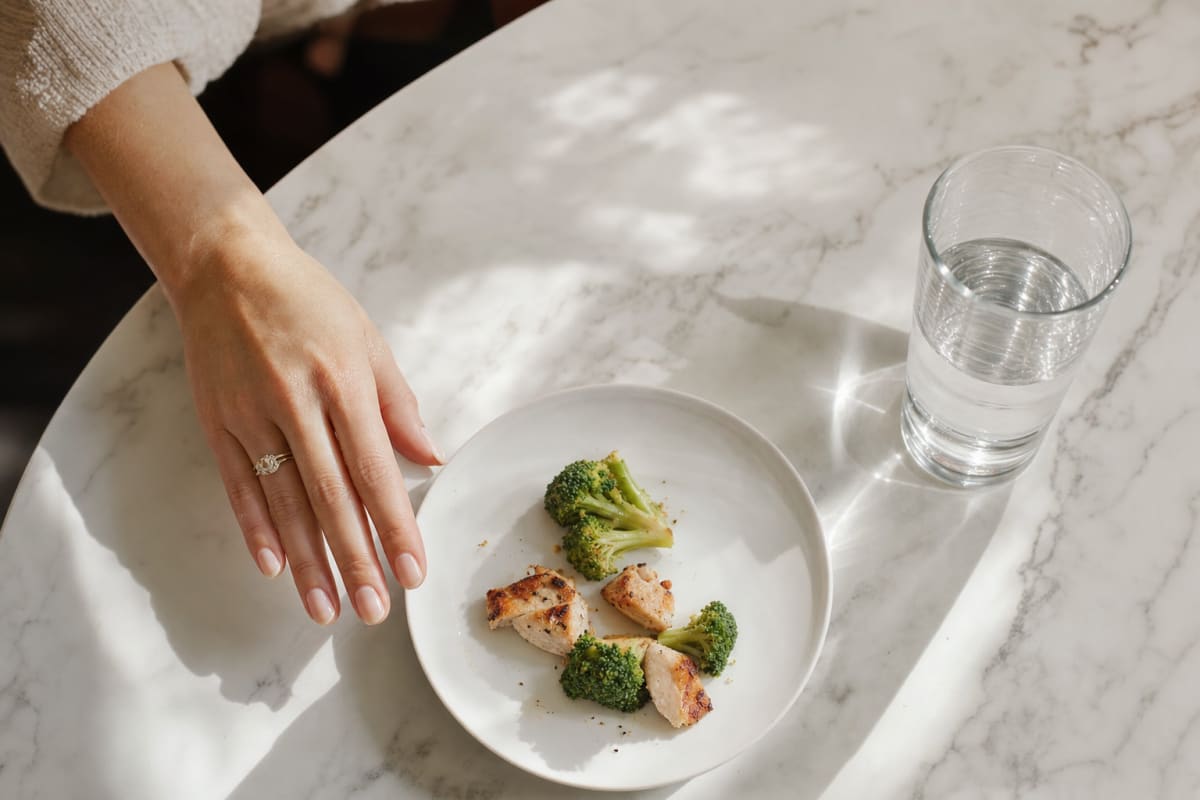
1. Eat 30 to 50% less and you're not just cutting calories. You're cutting everything.

A small portion of food on a plate

I'm full after about three bites now. Some days I look up and it's the evening and I've had a coffee and a few spoons of yogurt, and that's it.

That's the part nobody says out loud: when the food goes, everything in it goes too. Protein, iron, calcium, B12, magnesium. A 2025 review in Frontiers in Nutrition found people on these meds were coming up short on fiber, calcium, iron, magnesium, potassium and a string of vitamins.4 You can be losing weight and running on empty at the exact same time.

2. I kept calling it "tired." It was more than tired.

A woman worn out and low on energy, sitting on the edge of her bed

Run down. No gas in the tank by the afternoon. The kind of wiped-out that sleep doesn't fix.

I wanted it to be something dramatic. It wasn't. When you're barely eating, your body's running on fumes, and the dietitians who work with GLP-1 patients say low energy is one of the first things they look at. It tracks with how little you're getting in.

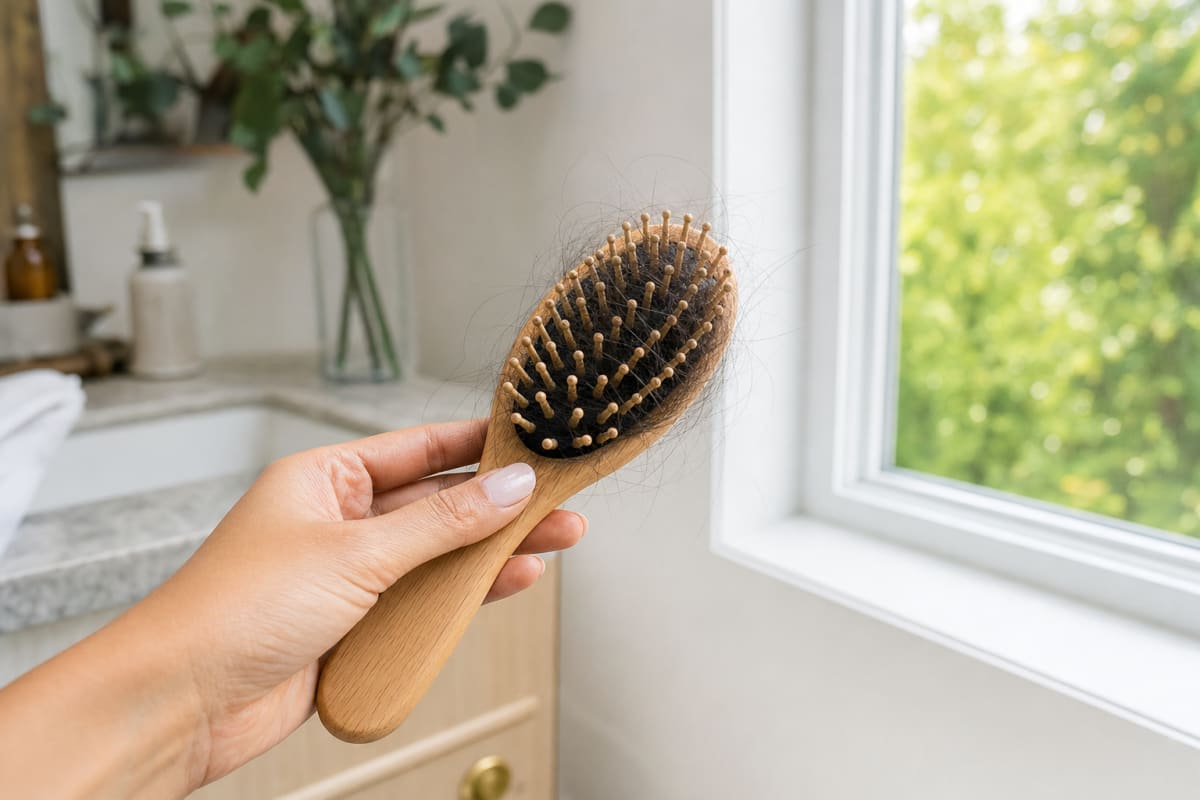
3. Then I started finding it in the shower drain.

A hairbrush with loose hair in a bright bathroom

Clumps. My brush full after one go. It scared me more than I let on.

It's a known thing with fast weight loss and low protein and nutrient intake, and the FDA's adverse-event system has logged more than a thousand hair-loss reports tied to these meds.5 I'm not going to tell you a scoop of anything regrows hair, because it doesn't. What I'll tell you is that the day I learned the link ran through nutrition, "am I even feeding myself" stopped being a vague worry and turned into a real question.

4. My arms went soft. Smaller, but not firmer.

A woman noticing her thinner, softer arm in the mirror

Deflated is the word I kept coming back to. Thinner everywhere, but the tone was just gone.

My doctor said it flat out: muscle is the first thing to go with fast weight loss. A joint advisory from four big medical and obesity groups put numbers on it, in one major trial about 38% of the weight people lost was lean mass, not fat.1 Their advice wasn't to stop. It was that what you eat matters more while you're eating less, not less. Muscle is the thing holding you up.

5. The food noise went quiet. Then I started forgetting to eat.

A woman at her kitchen counter looking at a barely-touched plate

For the first time in my life the chatter stopped. No negotiating with myself all day. I'd have given anything for that.

The catch is the hunger cues went with it. If I don't set a timer, the day just goes by and I haven't eaten. A registered dietitian at UCHealth said the thing that finally made it click for me: when you're eating about half what you used to, every bite has to count.

6. A multivitamin is a start. It's not a foundation.

So I bought one, like the Harvard piece suggested. Fine first step.

But it's a handful of isolated vitamins in a pill. On the days I'm barely eating, I wanted something closer to actual food, something that covered more than a few lines on a label. That's a different thing, and it's where I landed next.

7. The simplest thing I do now: one scoop, in a glass of water.

A glass of greens drink on a bright kitchen counter

I didn't want another routine. On a morning I'm forcing myself to eat, the last thing I need is five more bottles on the counter.

AG1 is one scoop in water, a whole-food-based daily foundation of 75 ingredients, including clinically studied probiotics for your gut, and it's clinically shown to close common nutrient gaps. I drink it with my protein, not instead of it. It's the one thing I can actually get down on a low-appetite morning when solid food isn't happening.

8. Run it past your doctor. This helps you while you eat less. It doesn't replace anything.

A patient talking with her doctor

I'll say it twice because it matters. AG1 is food-based daily nutrition. It's not a drug, it doesn't replace your medication or your protein or your doctor's plan, and you should clear anything new with whoever prescribed yours.

What it does is plain and worth doing: on the days I eat like a bird, it's how I make sure I'm at least getting something real in. For me that was the missing piece. Your doctor will know what's right for you.

Trusted by experts

The proof, plainly

A four-organization advisory

Four organizations (the American College of Lifestyle Medicine, the American Society for Nutrition, the Obesity Medicine Association, and The Obesity Society) advised in 2025 that dietary guidance for people on GLP-1s "should focus on ensuring nutrient adequacy within an often substantially lower-calorie diet."1

Harvard Health, March 2026

A Harvard Health review urged people on these meds to consider a daily multivitamin, vitamin D, iron and B vitamins especially. In one study of GLP-1 users, 72% came up short on calcium, 64% on iron, and just 1.4% hit their vitamin D target.2

UCHealth registered dietitian

When you're eating roughly half of what you used to, there's no room left for empty calories. As one who works with these patients puts it: "every bite needs to be nutritious."3

AG1 doesn't claim to fix any of this. It's a daily nutritional foundation, clinically shown to close common nutrient gaps, that you can lean on while you're eating less.

From AG1's 50,000+ verified 5-star reviews
★★★★★
"The one thing I can get down on a no-appetite morning."
Verified buyer
★★★★★
"Simplest part of my routine while I'm eating less."
Verified buyer
★★★★★
"I drink it with my protein and feel like I've covered my bases."
Verified buyer
★★★★★
"The one thing I can get down on a no-appetite morning."
Verified buyer
★★★★★
"Simplest part of my routine while I'm eating less."
Verified buyer
★★★★★
"I drink it with my protein and feel like I've covered my bases."
Verified buyer

Across 50,000+ verified 5-star reviews, "simple" and "every morning" are the words that come up most.

The offer

One scoop. The base you're missing while you eat less.

$79 a month on subscription, about $2.63 a day.

The first order comes with the welcome kit: travel packs, vitamin D3+K2 drops, a canister and a shaker. Cancel anytime.

See the AG1 offer

Talk to your prescribing doctor before adding any supplement while you're on a GLP-1.

AG1 Next Gen daily foundation: pouch, canister, scoop and D3+K2 drops

The scale was moving. I just wanted to know I was still feeding myself.

If you're eating a fraction of what you used to and you've clocked the energy, the hair, the soft arms, the nutrition underneath is worth a real look. One scoop a day covers a lot of base. Run it past your doctor, then decide.

See the AG1 offer

Questions, answered

I can barely eat. Is one more thing realistic?

It's a scoop of powder in water you sip, not another meal to get through. A lot of people find a cold glass easier than solid food when their appetite's gone.

Is this safe with my medication?

AG1 is food-based daily nutrition, not a drug. But anything you add while on a prescription should be cleared with your prescribing doctor or pharmacist first. Please do that.

Won't a cheap multivitamin do the same thing?

A multivitamin is isolated vitamins. AG1 is a whole-food-based foundation of 75 ingredients, clinically shown to close common nutrient gaps. Different breadth, different format.

Does it replace my protein shake?

No. Protein is its own priority while you're losing weight. AG1 is the daily base alongside your protein, not a swap for it.

What does it cost?

$79 a month on subscription, about $2.63 a day, with a welcome kit on the first order.